The QS World University Rankings (WUR) shines light on the best institutions from across the world by incorporating datapoints from 16.4 million academic papers as well as the views of more than 151,000 academics and 100,000 employers. QS WUR employs a range of vital factors including student experience, university partnerships, research activity and faculty qualifications. The 2026 edition of QS WUR features over 1,501 universities across 105 higher education systems.
QS World University Rankings: Sustainability provides students with a unique lens on which institutions are demonstrating a commitment to a more sustainable existence. It looks for outwards evidence of commitment, from the impact that alumni are making in science and technology to solve climate issues, to the impact of research being done across the UN’s 17 Sustainable Development Goals. The ranking evaluates the social and environmental impact of universities as a centres of education and research, as well as a major employers with the operational sustainability challenges of any large and complex organization.
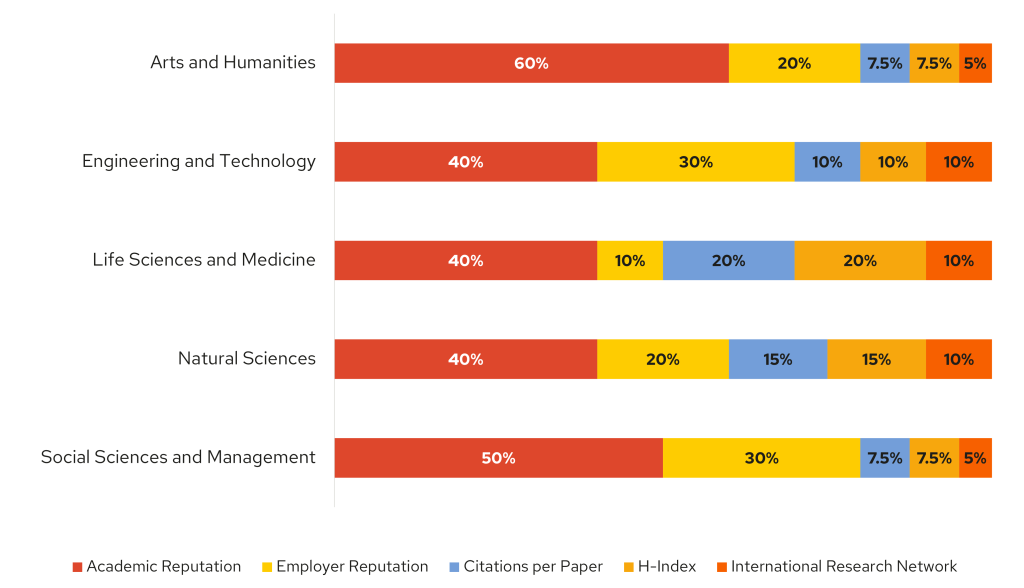
The QS World University Rankings by Subject provides students with information on institutions that are excelling in the subject areas that matter to them. This ranking provides individual ranking tables for both broad faculty areas and specific subjects. It consists of 50+ narrow subjects across five broad faculty areas:
Indicator weights are adjusted for the characteristics of each broad and narrow subject area.


THE has provided trusted performance data on universities for students and their families, academics, university leaders, governments and industry since 2004 through the THE World University Rankings (WUR). THE’s university rankings assess university performance on the global stage and to provide a resource for readers to understand the different missions and successes of higher education institutions. THE’s methodology judges research-intensive universities across all their core missions: teaching, research, knowledge transfer and international outlook. The 2026 edition of THE WUR ranks more than 2,000 research-intensive institutions from 115 countries and territories.
THE Impact Rankings assesses universities against the United Nations’ Sustainable Development Goals. THE Impact Rankings use carefully calibrated indicators to provide comprehensive and balanced comparisons on sustainability across four broad areas: research, stewardship, outreach and teaching.
The Impact Rankings are inherently dynamic: they grow rapidly each year as many more universities seek to demonstrate their commitment to delivering the SDGs by joining THE’s database. This system allows institutions to demonstrate rapid improvement year-on-year, by introducing clear new policies, for example, or by providing clearer and more open evidence of their progress.
The THE World University Rankings (WUR) by Subject’s 2025 methodology is designed to evaluate universities across 11 subject areas using a refined version of the overall World University Rankings 2025 methodology. Employing the same range of 18 performance indicators categorized under the five core pillars, THE provides a comprehensive view of academic and research excellence. The methodology is carefully adjusted for each subject, ensuring fairness and accuracy by considering field-specific research cultures and publication practices.


Initiated by Universitas Indonesia in 2010, the UI GreenMetric (UIGM) Sustainable University Rankings is a global initiative dedicated to assessing and promoting environmental sustainability within higher education institutions. Through a robust framework comprising 60 indicators across 7 criteria, UIGM objectively measures and benchmarks the environmental commitments and initiatives of universities worldwide. Since its inception, the ranking has grown from 95 participating universities across 35 countries in 2010 to 1,745 institutions across 105 countries in 2026.